Test strategy & coverage audit
We assess current coverage, identify critical gaps, and design a strategy that gives confidence in deploys, not just line numbers.
Test strategy, automated suites, and AI eval harnesses that catch real regressions before your users do — not vanity coverage numbers. Built for AI-integrated products and regulated platforms where a failed deploy costs more than a bug.
We assess current coverage, identify critical gaps, and design a strategy that gives confidence in deploys, not just line numbers.
Unit, integration, and end-to-end suites built to be maintained. We write tests that catch real regressions.
Eval harnesses for LLM and ML features. See AI quality below for the full picture.
PR checks, automated gates, and deployment pipelines that prevent regressions without slowing the team down.
Traditional tests check whether code does what it's supposed to. AI features don't have a single correct output — so "passing" has to be defined before it can be tested for.
Eval sets from real production inputs, not synthetic happy paths — tracked against a baseline so quality drift gets caught before users notice.
A prompt change or model version bump is a deploy. We test it like one — before it ships, not after a support ticket.
Token usage creeps as prompts grow. We instrument cost-per-interaction and latency as monitored metrics, not invoice surprises.
We test for malformed input, prompt injection, and out-of-scope questions — what users actually send, not the spec's happy path.
If your team hesitates before merging or runs manual smoke tests before every release, the problem is structural. We fix the test infrastructure, not the symptoms.
LLM outputs that worked last sprint started behaving differently this sprint. Without eval harnesses and baseline metrics, you won't know until a user reports it.
High line coverage built around implementation details means your tests pass when you change a variable name and break in production when a real assumption changes.
Features that break other features, bugs that pass code review, releases that need hotfixes within hours. Quality gates aren't slowing your team down — their absence is.
Teams preparing for SOC 2, HIPAA, or PCI-DSS evidence requests often need more than green CI checks — they need traceable test evidence, coverage history, and release records.
Your QA queue is the last thing between code and production. Every release waits on it. The fix isn't more testers — it's moving quality earlier and automating what doesn't need a human eye.
We map what actually needs coverage — critical paths, compliance-relevant logic, AI output boundaries — before a single test is written.
PR checks, automated regression suites, and deployment gates run on every change. Quality is enforced by the pipeline.
For LLM and ML features, we define acceptance criteria and baseline metrics before launch, then monitor for silent drift.
The team that designs your test strategy stays through implementation and into steady-state. You inherit a maintainable suite.
We track what matters — payment paths, PHI-handling code, AI inference boundaries, and other areas where regressions create real product or compliance risk.
Flaky tests and silent regressions are usually symptoms of earlier architectural decisions. We flag those, not just failing assertions.
Test evidence and coverage history stay current, so a compliance ask doesn't turn into a scramble.
 Life Sciences
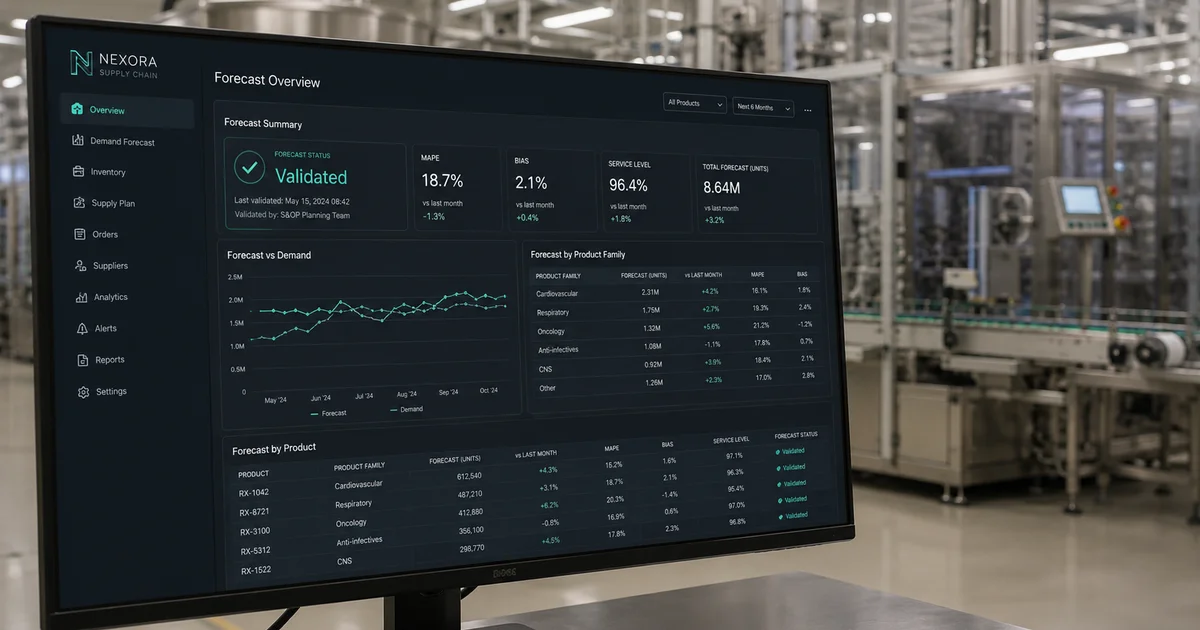
 A pharma supply chain forecasting model had been in internal development for nine months but could not reach production. We rebuilt the pipeline with GxP-aligned validation, audit logging, and a QA-owned kill-switch — and deployed to production in 90 days with a validation package the regulatory team accepted without revision.
Read case study FinTech
 Replaced a fragile PHP monolith handling €40M annual payment volume with an event-driven microservices architecture — achieving PCI-DSS Level 1 compliance and unblocking a €12M Series C.
Read case study Healthcare
 Developed an AI-powered platform delivering personalised care pathways from EHR, wearable, and genetic data — built to HIPAA-compliant architecture standards, with a 30% increase in patient adherence to preventive care plans.
Read case studyWe do not frame this as replacing your QA team or adding generic staff. We build the quality infrastructure layer your team may not have time to own: automated gates, eval harnesses, CI/CD checks, and release evidence. The goal is to move QA effort away from repeated release firefighting and toward exploratory testing, product review, and evidence-based release decisions.
Yes — deterministic test suites are not enough for this problem. We define acceptance criteria before the first eval runs: acceptable accuracy ranges, latency budgets, edge-case failure modes, and baseline metrics tied to real or representative inputs. The approach is designed for LLM features, ML classifiers, and AI-assisted workflows where "correct" is often a distribution, not a single fixed value.
Coverage measures which lines were executed during a test run. It says nothing about whether the right things were tested, whether the assertions caught anything meaningful, or whether the suite models real user behavior. A high coverage score built around implementation details can still miss payment paths, data sync, role-based access, or AI output boundaries. We audit what your tests actually assert, identify the gaps that let regressions through, and redesign the suite around risk — not line counts.
Yes. We work inside your existing pipeline rather than creating a separate process your team has to remember to check. Whether the setup uses GitHub Actions, GitLab CI, CircleCI, Jenkins, or a custom workflow, the goal is to make quality gates part of the release path. If pipeline changes are required, call them out before implementation.
Book a call and we'll review your current test coverage and deployment process. Scoped within a Pilot or Build engagement, or as a standalone retainer.