A patient-intake AI was running GPT-4o for every interaction — accurate but too slow and expensive for clinical workflow requirements. We rebuilt the pipeline as a routed multi-model system: small models for triage routing, larger models only when complexity requires it. Deployed to production in 14 weeks. One-third the inference cost, half the latency, same clinical accuracy on the evaluation set.
The demo worked. Production is a different problem.
88% of AI pilots never reach production. The gap is not the model — it is data readiness, integration dependencies, latency constraints, and compliance architecture. We validate all of it in three weeks.
The gap between demo and production is an engineering problem.
Most AI pilots fail for predictable reasons — not because the technology doesn't work, but because production assumptions were never tested.
Data that worked in the demo doesn't exist in production
The pilot used curated data. Production data is inconsistent, schema-drifted, and arrives late. Models trained on clean data degrade on live data within weeks.
Latency that's fine in a notebook is too slow in a workflow
A 4-second LLM response is tolerable in a demo. It kills adoption in a real clinical, support, or underwriting workflow. Production AI needs latency architecture designed before the model is chosen.
Compliance requirements that were assumed away in the PoC
HIPAA, PCI-DSS, GDPR, and explainability requirements were not in scope for the demo. They are in scope for production. Retrofitting compliance into a deployed system is significantly more expensive than designing for it from the start.
No integration with the systems that matter
The PoC ran in isolation. Production needs to read from the EHR, write to the CRM, trigger the workflow, and send the notification. Each integration adds dependencies, failure modes, and latency.
Nobody owns what happens when the model is wrong
The demo showed the model being right. Production requires a defined failure mode, a human-in-the-loop mechanism, an audit trail, and a process for handling outputs that reach a customer or a regulator.
The PoC team is no longer available
The consultant, the intern, or the vendor who built the demo is gone. The codebase is a notebook and a Slack thread. A new team cannot extend it without understanding what it actually does.
What comparable engagements delivered.
Product Pilot is the service path.
The Product Pilot is built for exactly this problem: three weeks, experienced engineers, working software, and a clear recommendation on whether and how to proceed to a full build.
See Product Pilot details →- Data readiness and pipeline architecture assessment
- Compliance gap analysis (HIPAA, PCI-DSS, GDPR)
- Production latency and integration validation
- Human-in-the-loop and audit trail design
- Build plan and effort estimate for the full production system
Nine months stuck in development. Production in 90 days.
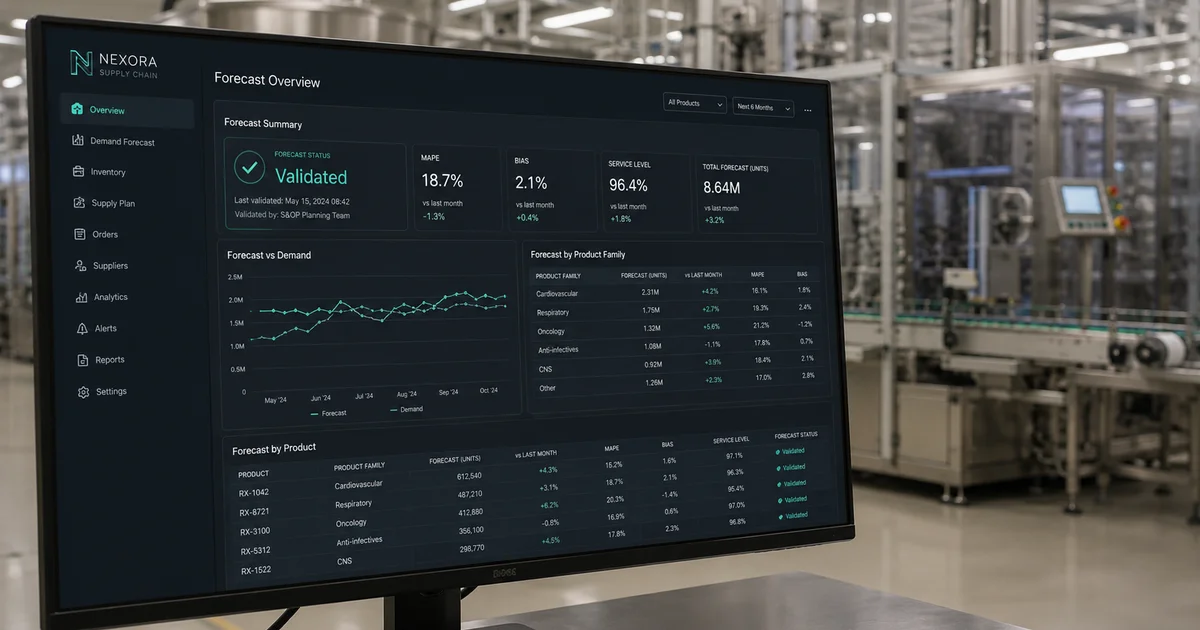
Life Sciences Pharma Supply Chain Forecasting: 9 Months of Development to Production in 90 Days
A pharma supply chain forecasting model had been in internal development for nine months but could not reach production. We rebuilt the pipeline with GxP-aligned validation, audit logging, and a QA-owned kill-switch — and deployed to production in 90 days with a validation package the regulatory team accepted without revision.
Read case studyWhat clients say about working with us.
Ready to know whether your PoC can ship?
Book a technical call. We'll ask about the model, the data, the workflow it needs to fit into, and what production actually requires — then tell you what we think.
Book a 30-min technical callAn experienced engineer replies within one business day, often faster.